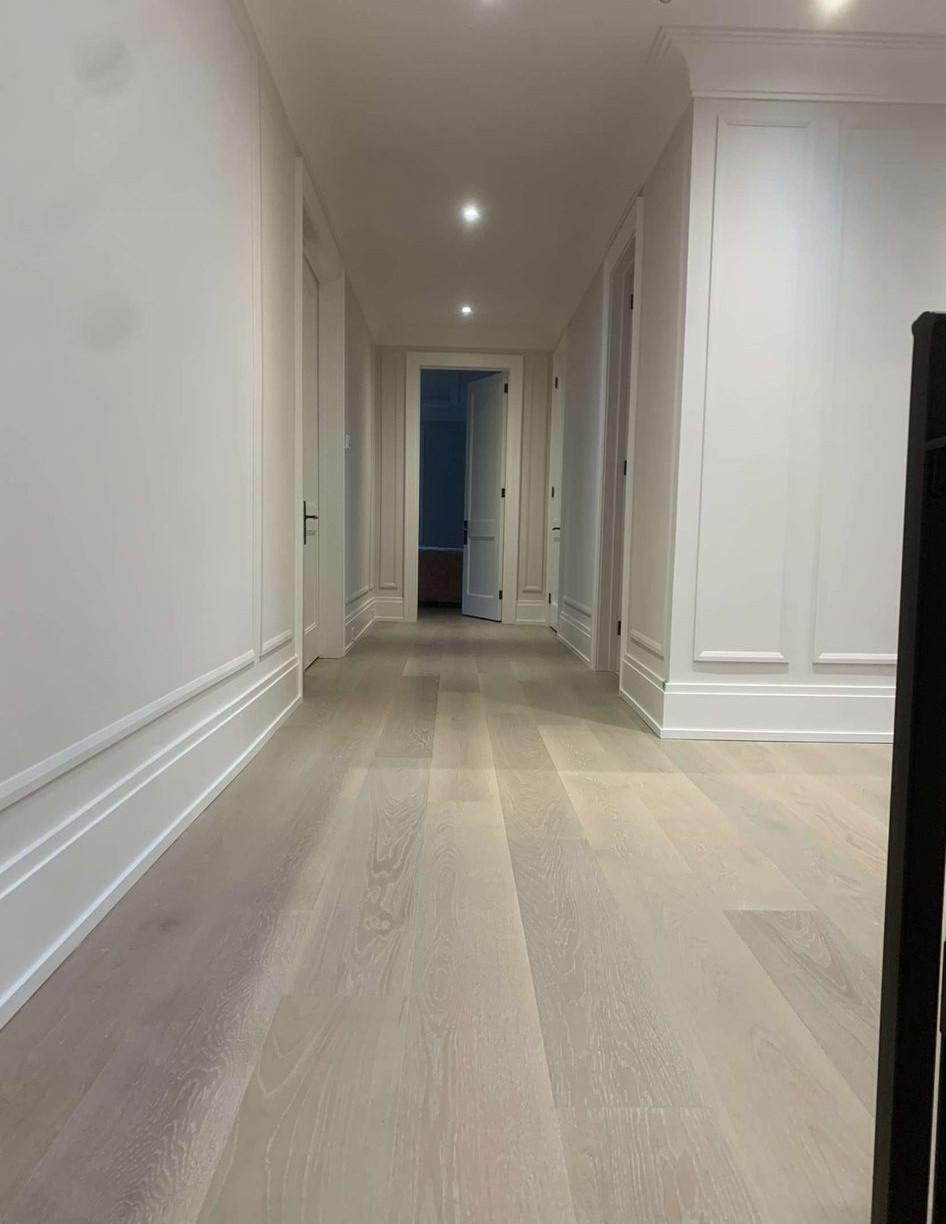
Flooring Installation in Toronto
Flooring installation in Toronto is not one market, and we work across the whole City of Toronto. The flooring job in a Cabbagetown Victorian is nothing like the job in a Liberty Village condo, and the bungalow in Etobicoke is different again. We install hardwood, laminate, vinyl/LVP, tile, and carpet across all of it, but the right product and the right approach depend heavily on what kind of building you're working in.
Toronto's Housing Eras and What They Mean for Flooring
Most Toronto neighbourhoods can be sorted by when they were built, and that era tells us a lot about what we'll find under the existing floor.
The pre-1920s Victorian and Edwardian housing stock, concentrated in the Annex, Cabbagetown, Riverdale, Roncesvalles, Leslieville, and the western Beaches, sits on softwood subfloors that have settled, sagged, and been patched many times over a century. Original strip hardwood is often hiding beneath carpet from a 1980s renovation. Whether to refinish what's there or remove and replace is usually the first decision, and it's site-dependent. Where the original is sound and worth keeping, sanding and refinishing produces a result no new product matches. Where it's beyond saving, levelling the subfloor properly is more than half the job, getting it right is what separates a floor that lasts from one that telegraphs every flaw underneath.
Post-war detached homes, common throughout Etobicoke, East York, and the older parts of North Toronto and Leaside, have plywood or board subfloors and tend to be more straightforward. The challenges in this stock are typically renovation-driven: removing walls and merging rooms, which means matching new hardwood to existing runs or starting over with a continuous floor across the whole main level. We do a lot of this work in the Beaches, Mount Pleasant, and the Bloor West Village area.
Late-century and 1990s infill, found across the city in pockets, but especially in places like Liberty Village's earliest townhomes and the redeveloped sections of the Junction, uses standard wood-frame construction over concrete or wood subfloors. These are usually the simplest jobs technically but often involve tight schedules and shared-wall acoustic considerations.
And then there's the condo market. Toronto's high-rise stock, CityPlace, King West, Liberty Village, the Yonge corridor from Yorkville up through Yonge-Eglinton, and the entire waterfront, is built on concrete slabs. Concrete dictates everything that follows. Solid hardwood doesn't go over concrete; engineered hardwood or LVP does. Most buildings impose minimum acoustic underlayment ratings (usually expressed as an IIC value), and many require board approval and a flooring inspection before work can begin. We've handled enough of these projects to know which buildings have the most demanding requirements and how to package the documentation so approval doesn't drag.
Flooring Choices Worth Considering in Toronto
Engineered hardwood is our most-recommended product for Toronto condos and for detached homes where the basement is finished to the same level as the main floors. It handles humidity swings better than solid wood and works directly over concrete with the appropriate adhesive. Wide-plank white oak in particular has become the default spec for higher-end Toronto renovations.
Solid hardwood remains a strong choice for above-grade floors in detached and semi-detached houses with wood subfloors. The advantage over its engineered counterpart is that it can be sanded and refinished multiple times, a 100-year-old Toronto floor that's been refinished four times still has life in it. For heritage homes in the Annex or Cabbagetown, this matters.
Luxury vinyl plank has changed what's possible in Toronto basements. The waterproofness handles below-grade moisture without complaint, and the better products are now nearly indistinguishable from real wood at conversational distances. We install it constantly in finished basements across the city and in condos where budget or building rules push against engineered hardwood.
Tile installation in Toronto is mostly bathroom and kitchen work, plus the occasional entryway. Heated tile floors are increasingly common in primary bathroom renovations, well worth the small additional cost in a city with five months of winter.
Toronto Neighbourhoods We Serve
We work across the city: the Annex, Bayview Village, the Beaches, Bloor West Village, Cabbagetown, Cliffside, Davisville, the Distillery District, Don Valley Village, the Entertainment District, Etobicoke (Mimico, New Toronto, Long Branch, Islington-City Centre), Forest Hill, Harbourfront, High Park, Junction Triangle, the Junction, King West, Lawrence Park, Leaside, Leslieville, Liberty Village, Little Italy, Midtown, Mount Pleasant, North Riverdale, Parkdale, Riverdale, Rosedale, Roncesvalles, St. Clair West, Swansea, Trinity-Bellwoods, the Waterfront, Wychwood, Yonge-Eglinton, Yorkville, and the rapidly developing pockets in between.
What Working with a GTA-Based Crew Gets You
Toronto traffic and parking add real cost to any contractor's day. We factor it into our scheduling rather than into your invoice, the estimate you get is the price for the work, not the price for the work plus a Bay Street parking surcharge. We know which buildings have loading docks and which require service-elevator booking. We know which condo boards require specific contractor insurance certificates and which just need a floor plan. None of this comes up in a generic quote, and all of it affects whether your flooring project finishes on schedule.
We serve clients in Scarborough, North York, Vaughan, Markham, Mississauga, and Pickering as well, call us if you're outside the city limits and we can confirm coverage for your address.
Free Flooring Estimate in Toronto
Call (647) 905-0050 or use the contact form to book a free on-site estimate. We respond same-day on most requests and can usually be on-site within 24 to 48 hours.
Request a Free Estimate